Birds that commonly use nest boxes in Delaware include Eastern Bliebirds, Tree Swallows, Carolina Chickadees, and House Wrens.
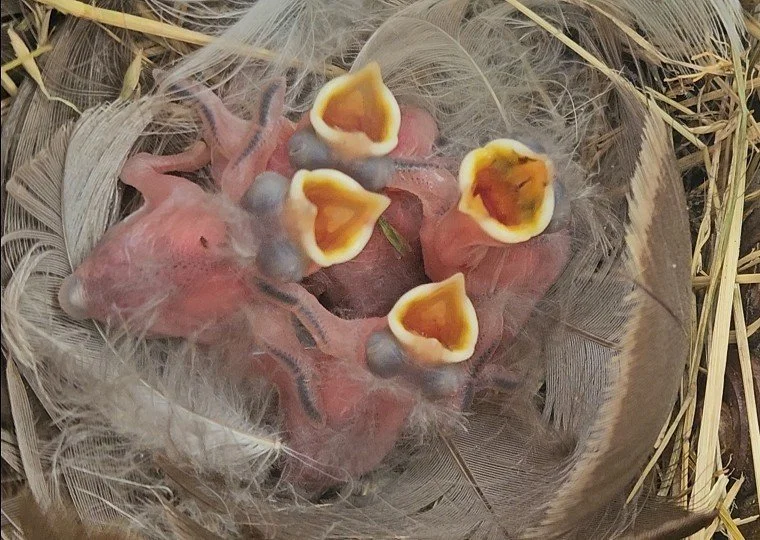
Newly hatched Tree Swallows
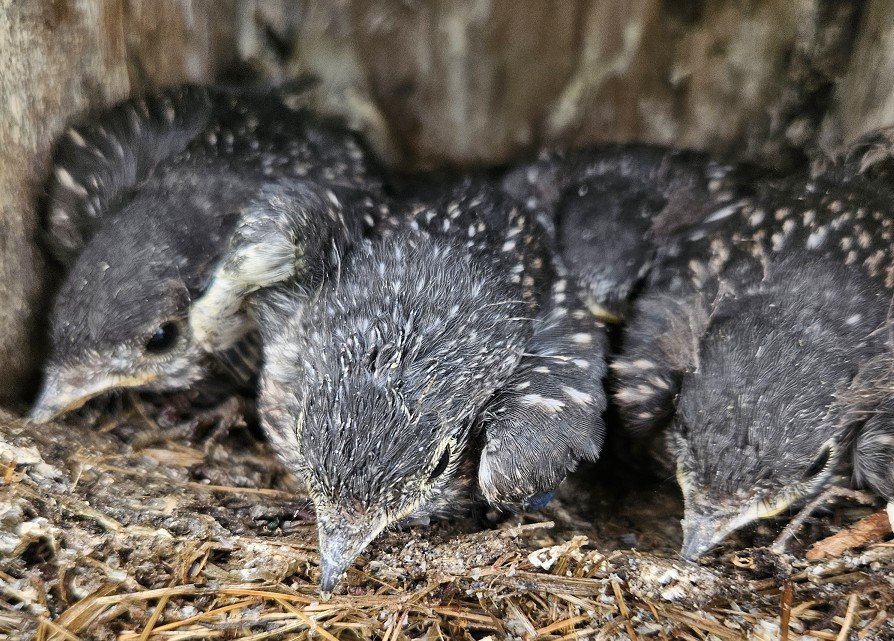
13-day-old Eastern Bluebird chicks
House Wrens and Carolina Chickadess
Both will nest in urban neighborhoods
Both use boxes with 1 1/4” openings which will exclude non-native House Sparrows
Eastern Bluebirds and Tree Swallows
Both require open areas
Both require openings of at least 1 1/2” which will NOT exclude non-native House Sparrows
Incubation period {days} Brood period (days)
House Wrens 14 15
Carolina Chicikadees 13 17
Easterm Bluebirds 14 17
Tree Swallows 15 20
Perform nest checks not earoer than 2 hours after sunrise and up to 2 hours be
fore sunset, and never in the rain. If recording data for NestWatch, for each nest record the date, nest box number number of eggs and/or number of chicks in the nest. Ideally, nest should be checked at least every 5 to 7 days in order to quickly address problems.
Always use predator guards on all next boxes. Potential predators include racoons and snakes. Ants also destroy eggs and chicks in nests. If ants are anticipated or observed, add 1 -2 tabpespoons of diatamaceous earth or Sevin dust under the nest.
Plans for nest box designs can be found at the All About Birdhouses page on the NestWatch website
For further information, send an email to info@delawareaudubon.org.