2025 Conservation Grant Projects
Coastal Watershed Model
dr. Heidi Gurdo
Delaware Technical Community College
Stanton Campus
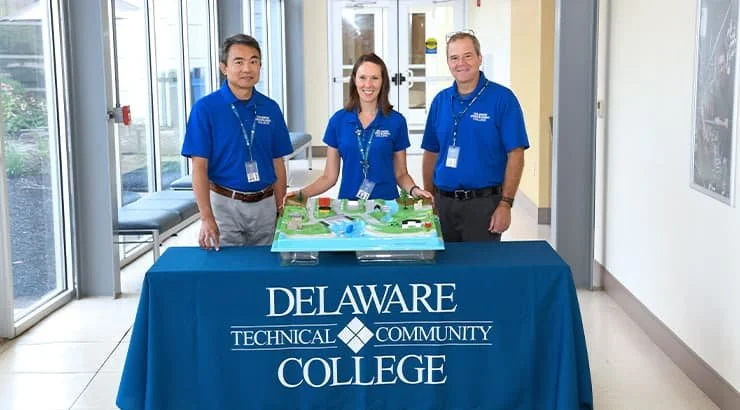
Stanton Campus ACCEE faculty stand with the new coastal watershed table (left to right): YuanChi (Daniel) Liu, Ph.D., P.E., PMP, CEM, LEED AP; Heidi Gurdo, Ed.D.; and Kyle J. Lampron, P.E.
The Delaware Audubon Society awarded the 2025 Delaware Audubon Conservation Grant to Delaware Technical Community College’s Architecture, Construction Management, Civil, and Environmental Engineering (ACCEE) Department at the Stanton Campus.
The grant funded the acquisition of a coastal watershed exhibit, an interactive educational model that demonstrates stormwater movement and pollution pathways within a coastal watershed system. This hands-on tool is especially relevant in Delaware, where coastal wetlands, estuaries, and barrier beaches support a rich variety of migratory and resident bird species.
The coastal watershed model illustrates how pollutants affect interconnected ecosystems—including wetlands, groundwater, estuaries, beaches, barrier islands, and shellfish beds—that serve as important habitat for many bird populations. It also highlights human‑related influences such as leaking underground storage tanks, septic systems, storm drains, oil spills, and dredging, all of which can impact overall ecosystem quality and the wildlife that depends on it.
Delaware Tech’s ACCEE department uses the exhibit in classrooms, community workshops, and outreach events throughout the state. Its interactive format supports efforts to expand environmental literacy, increase awareness of Delaware’s coastal resources, and promote STEM pathways related to civil and environmental engineering and sustainable infrastructure.
By using this model in its outreach programming, Delaware Tech enhances community understanding of coastal watershed systems and the environmental factors that affect them. This work complements the Delaware Audubon Society’s broader efforts to support environmental education across the state.
As a durable, reusable resource, the exhibit will continue to support instruction and outreach across multiple academic years. This grant enables Delaware Tech to offer expanded educational opportunities that help communities learn more about Delaware’s coastal and environmental systems and the wildlife they support.
Signs to Protect the Horseshoe Crab
Sofia Trone
Purdue University
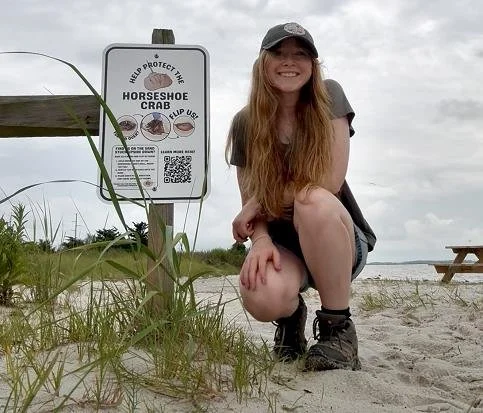
Purdue University undergrad Sofia Trone with sign on Delaware bayshore
The horseshoe crab (Limulus polyphemus) is a species that predates dinosaurs and has been in our costal ecosystems for millions of years. During this time, they have formed a critical ecological relationship with the Red Knot (Calidris canutus), a migratory shorebird that depends on annual Atlantic horseshoe crab spawning events in the Delaware Bay. Despite their ecological importance, horseshoe crabs are increasingly threatened by human encroachment into their natural habitats. Declines in the horseshoe crab population have resulted in less spawning activity and fewer eggs, a vital food source for Red Knots migration. The decrease in horseshoe crab populations can be directly contributed to the decline in the Red Knot population and its Threatened status.
“Help Protect the Horseshoe Crab,” a campaign founded by a Purdue student studying ecology, teamed up with Delaware Department of Natural Resources and Environmental Control and The Center for Inland Bays to create educational signs that serve as guides for horseshoe crab protection. With the help of the Delaware Audubon, nine educational signs were produced and placed around Delaware’s Inland Bay, critical breeding grounds for the horseshoe crab. These signs provide guidance on appropriate interactions with overturned horseshoe crabs and include information on their ecological significance. Each sign also features a voluntary survey used to evaluate the effectiveness of signage as a conservation tool. Horseshoe crabs and Red Knots are an iconic duo within the Delaware Bay and serve as important indicators of ecosystem health. These educational signs are intended to foster community awareness of this ecological relationship while offering clear, accessible actions individuals can take to support both species.
Evaluating a novel, upcycled feed for insectivorous birds
Destiny Mann
University of Delaware
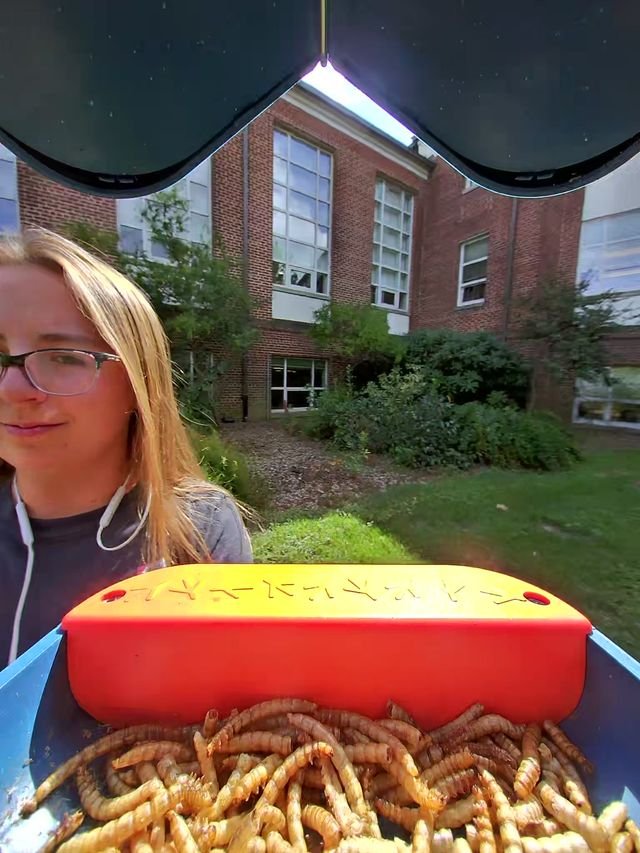
Destiny Mann at soldier fly larvae feeder
Food waste constitutes approximately 20% of municipal solid waste in U.S. landfills. Fruits and vegetables represent the largest category of food loss at the consumer level, followed by dairy, meat, and grains. An insect upcycling system can offer a promising approach to convert food waste into valuable products such as insect biomass. Black soldier fly larvae (BSFL) can process meat and dairy products, which are typically excluded from other waste diversion methods, and they are known as a possible protein alternative in poultry diets. Wild birds provide important ecosystem services, and many bird species incorporate insects into their diets. Increasing insect availability on the landscape through BSFL-based waste upcycling may therefore provide supplementary food resources for nesting and migrating birds.
To evaluate if wild birds would use BSFL as a food source, bird feeders equipped with cameras were paired and one was stocked with dried mealworms while the other was stocked with BSFL. They were put out for a year and monitored alongside point counts and citizen science observations. The point counts supported that for all the insectivorous birds reported, they were also captured by the bird feeders. For the bird feeders, there were many visits to both feed types from a variety of species including: cardinal (Cardinalis cardinalis), song sparrow (Melospiza melodia), carolina wren (Thryothorus ludovicianus), black capped chickadee (Peocile atricapillus), starling (Sturnus vulgaris), and chipping sparrow (Spizella passerina). However, visitations ceased across bird feeders for a period of nearly 2 months after nesting season (September-October) for some of the resident birds (cardinal, carolina wren, and song sparrow) and before fall migration birds (black capped chickadees). The most interesting observation to come from the bird feeders was the presence of squirrels on the feeders with mealworms but not BSFL. They would consume all the mealworms, even if it meant breaking a baffle, while they left the black soldier fly larvae untouched without the need to put up a baffle. Ultimately, we found that a wide community of birds do utilize BSFL as a feed source when given the option but they do feed at mealworm filled feeders more often. This finding suggests that BSFL-based systems may support avian use, highlighting their potential as a low risk waste upcycling strategy with ecological benefits.
Radio-tracking Wood Thrushes from fine-scale to continental scale
Ian Stewart
Delaware Nature Society
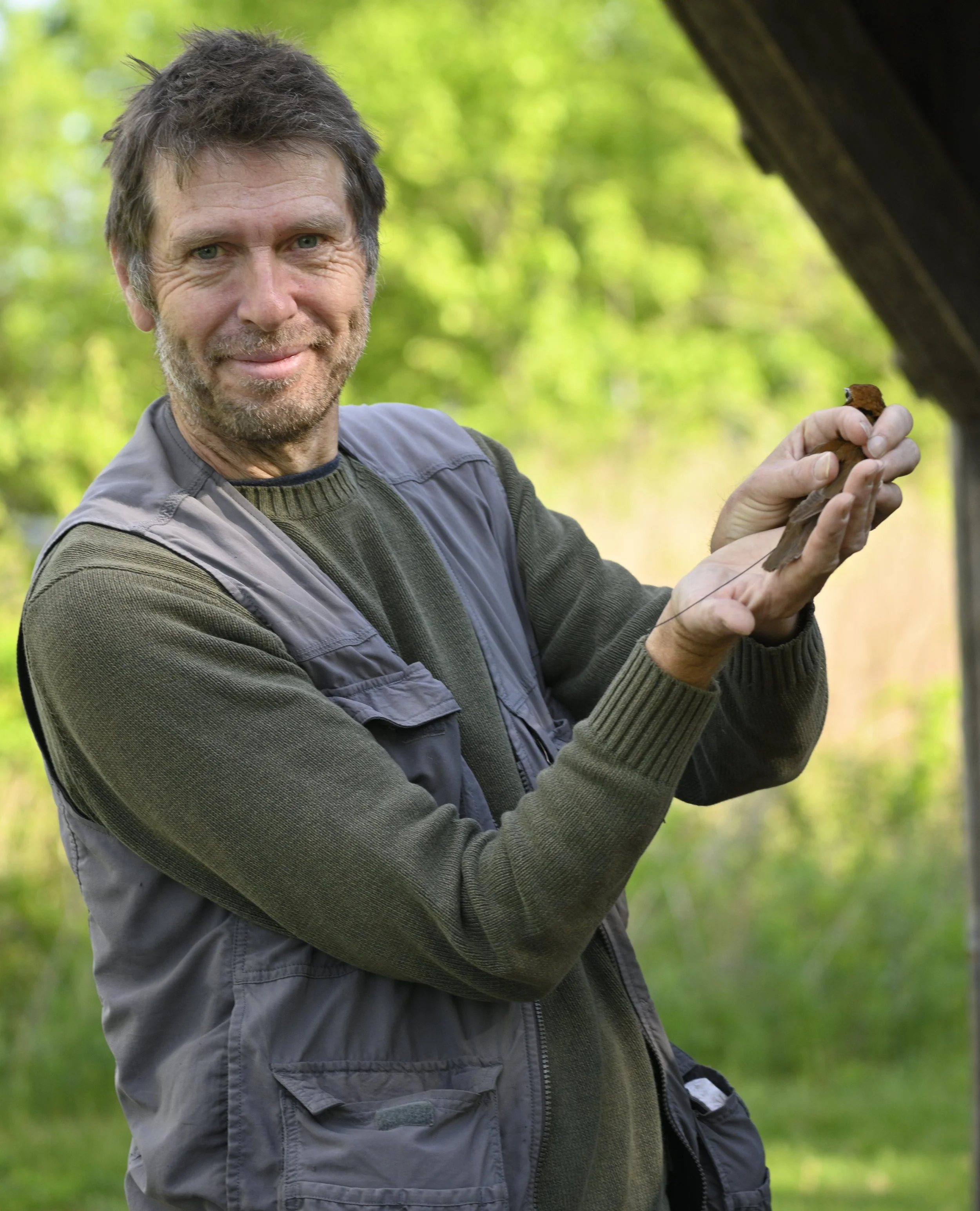
Ian Stewart with radio tagged Wood Thrush
The Wood Thrush (Hylocichla mustelina) is an iconic songbird of eastern woodlands which
unfortunately is in steady decline, with 6 out of 10 birds lost in the last 50 years. To investigate
the causes of this decline the US Fish and Wildlife Service initiated a massive study in which
adults and juveniles were radio-tagged in 27 states then the Motus automated telemetry
network (www.Motus.org) was used to identify their southward migratory routes, their non-
breeding grounds, and their survival between migratory stages. Thanks to Delaware Audubon
funding, I was able to participate in this study while also collecting data on the birds’ nesting
habitat and local movements using a hand-held manual receiver. In 2025, I found 56 Wood
Thrush nests, of which 50 (90%) were built in a native shrub (most often spicebush, Lindera
benzoin) at a height of 6ft or less. In 2025 I deployed radio-tags on 32 Wood Thrushes, 10 of
which had been purchased through a Delaware Audubon grant. I tracked 28 birds using the
manual receiver 1-5 times at approximately weekly intervals and found that all except 1 was
consistently detected in the section of woods in which it had been tagged. This showed that
birds move relatively little during the breeding season. We had departure dates for 11 of these
birds and found that they all started migrating within a narrow interval between September 23 rd
and October 1 st . Interestingly, 5 of them left the night of September 26 th when there was a
sudden drop in atmospheric pressure. 30 of the 32 birds we tagged were tracked outside of the
state, with 10 being detected by Motus towers located in forests in Central America (4 in Belize,
2 in Costa Rica, and 4 in Honduras). These forests in Belize and Honduras represent 2 of the 5
‘great forests of Mesoamerica’, which is further evidence that these forests are critical habitat
for millions of North American birds during non-breeding season. The other 20 tagged birds
were last detected in South Carolina, Georgia and Florida. In sum, this project has provided
important data on local habitat use of these classic forest birds as well as contributing valuable
data to the range-wide study aiming to reverse the decline of Wood Thrushes by identifying the
areas in which they concentrate during migration and the non-breeding season.