2025 Conservation Grant Projects
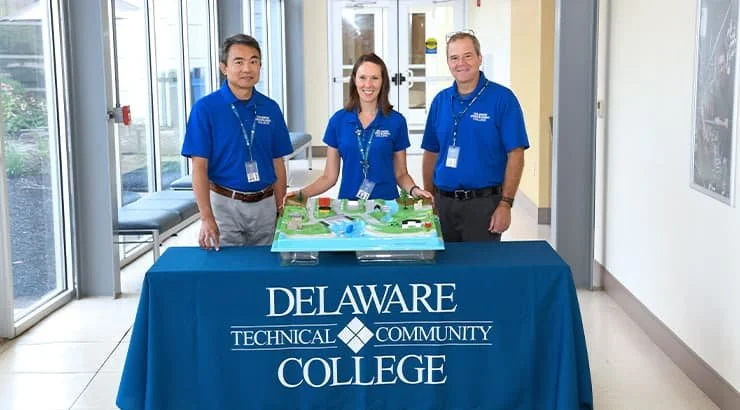
Stanton Campus ACCEE faculty stand with the new coastal watershed table (left to right): YuanChi (Daniel) Liu, Ph.D., P.E., PMP, CEM, LEED AP; Heidi Gurdo, Ed.D.; and Kyle J. Lampron, P.E.
Coastal Watershed Model
Delaware Technical Community College’s Architecture, Construction Management, Civil, and Environmental Engineering (ACCEE) Department at the Stanton Campus has been awarded the 2025 Delaware Audubon Conservation Grant.
Presented by the Delaware Audubon Society, the grant will fund the acquisition of a coastal watershed exhibit, a hands-on educational model that demonstrates stormwater movement and pollution pathways within a coastal watershed system. This exhibit is especially relevant to programs in Delaware, a coastal state with extensive estuarine and marine environments.
The coastal watershed model offers a comprehensive, interactive demonstration of how pollution affects coastal ecosystems—including wetlands, groundwater, estuaries, beaches, barrier islands, and shellfish beds. It also highlights human-related impacts such as leaking underground storage tanks, septic systems, storm drains, oil spills, and dredging.
"With its interactive and visually engaging format, the exhibit is ideal for use in classrooms, at outreach events, and during community workshops with youth and adult audiences alike," said Heidi Gurdo, ACCEE department chair at the Stanton Campus. "It supports our department’s goal to expand educational and career pathways by promoting Delaware Tech programs, emphasizing STEM and environmental careers, and connecting prospective students with opportunities in fields such as environmental engineering and sustainable infrastructure."
As the ACCEE department continues to grow its outreach efforts across the state, the coastal watershed exhibit will complement existing interactive tools and enhance its ability to engage with the public. This initiative will foster environmental literacy, promote sustainability, and help attract students from diverse and underrepresented backgrounds to STEM and environmental fields. It also aligns closely with the Delaware Audubon Society’s mission to support habitat improvements, scientific research, and environmental education throughout Delaware.
"As a reusable and durable resource, the exhibit represents a sustainable use of funds and will continue to support instruction and recruitment across multiple academic years," said Gurdo. "In short, this grant strengthens our capacity to deliver impactful outreach, align academic content with workforce needs, and provide accessible, high-quality learning experiences that support student success and career readiness."
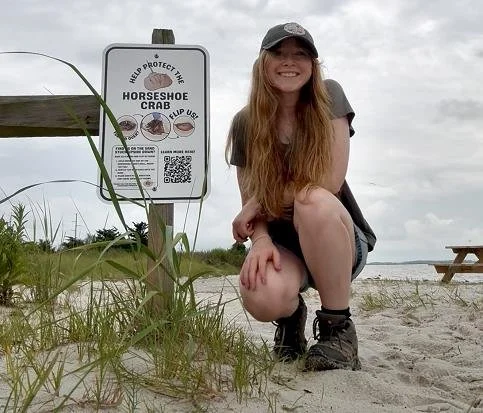
Sofia Trone with sign on the Delaware bayshore
Signs to Protect the Horseshoe Crab
The horseshoe crab (Limulus polyphemus) is a species that predates dinosaurs and has been in our costal ecosystems for millions of years. During this time, they have formed a critical ecological relationship with the Red Knot (Calidris canutus), a migratory shorebird that depends on annual Atlantic horseshoe crab spawning events in the Delaware Bay. Despite their ecological importance, horseshoe crabs are increasingly threatened by human encroachment into their natural habitats. Declines in the horseshoe crab population have resulted in less spawning activity and fewer eggs, a vital food source for Red Knots migration. The decrease in horseshoe crab populations can be directly contributed to the decline in the Red Knot population and its near-threatened status.
“Help Protect the Horseshoe Crab,” a campaign founded by a Purdue student studying ecology, teamed up with Delaware Department of Natural Resources and Environmental Control and The Center for Inland Bays to create educational signs that serve as guides for horseshoe crab protection. With the help of the Delaware Audubon, nine educational signs were produced and placed around Delaware’s Inland Bay, critical breeding grounds for the horseshoe crab. These signs provide guidance on appropriate interactions with overturned horseshoe crabs and include information on their ecological significance. Each sign also features a voluntary survey used to evaluate the effectiveness of signage as a conservation tool. Horseshoe crabs and Red Knots are an iconic duo within the Delaware Bay and serve as important indicators of ecosystem health. These educational signs are intended to foster community awareness of this ecological relationship while offering clear, accessible actions individuals can take to support both species.